
Sublimation Printing Explained: How It Works and Which Fabrics Suit It
Sublimation is the most common way to put full-color, edge-to-edge designs on team kits and activewear. This guide explains the process in plain terms, which fabrics work, and what to prepare before you ask a manufacturer for a quote.
- Sublimation turns dye into gas so it bonds with polyester fibers. It is not a layer of ink on top of the fabric.
- It works on polyester and high-polyester fabrics, and the lighter the base color, the truer the print.
- Cotton, dark fabrics and white ink are the main limits.
- Good artwork files and a clear color brief matter more than any other step.
How sublimation printing works
Sublimation is a heat transfer process. The design is first printed in special dye onto transfer paper. The paper is then pressed against the fabric at high heat, commonly around 190 to 205°C (375 to 400°F), with pressure for a short time. At that temperature the dye turns from a solid to a gas and moves into the polyester fibers. When it cools, the dye is locked inside the fiber.
That is why a sublimated design does not crack, peel or feel like a patch of plastic. You can run a hand over a printed area and feel the same fabric as the unprinted area. It also explains why the process only suits certain materials.
- Artwork is preparedColors, logos, names and numbers are laid out on a template that matches each garment panel.
- The design is printed on transfer paperA sublimation printer prints the mirror image of the design in dye.
- Heat and pressure transfer the dyeThe paper and fabric are pressed together so the dye enters the fibers.
- Panels are cut and sewn, or finished pieces are checkedDepending on the workflow, fabric is printed first and then cut, or panels are printed to shape. Ask which method applies to your order.
Which fabrics suit sublimation
The dye bonds with polyester, so the fabric content decides the result. As general guidance, 100% polyester gives the brightest and most durable color. Blends can work, but the lower the polyester share, the more washed out the print looks, because the non-polyester fibers do not hold the dye. The sportswear fabric guide covers common polyester blends in more detail.
| Fabric or base | Sublimation result | Notes |
|---|---|---|
| 100% polyester, white or light | Best | Bright, sharp color that stays in the fiber. |
| Polyester-rich blends | Good, slightly softer color | Ask for a printed sample of your artwork on the exact fabric. |
| Cotton or low-polyester blends | Poor | Color looks faded and fades faster. Consider screen print, heat transfer or embroidery instead. |
| Dark or black polyester | Poor | Sublimation dye is translucent, so it cannot cover a dark base. |
What sublimation does well
Because the print is part of the fabric, sublimation suits designs that would be hard to build from separate pieces: gradients, repeating patterns, camouflage, splatter effects and large graphics that run across seams. It also keeps the fabric light and breathable, which matters for performance wear.
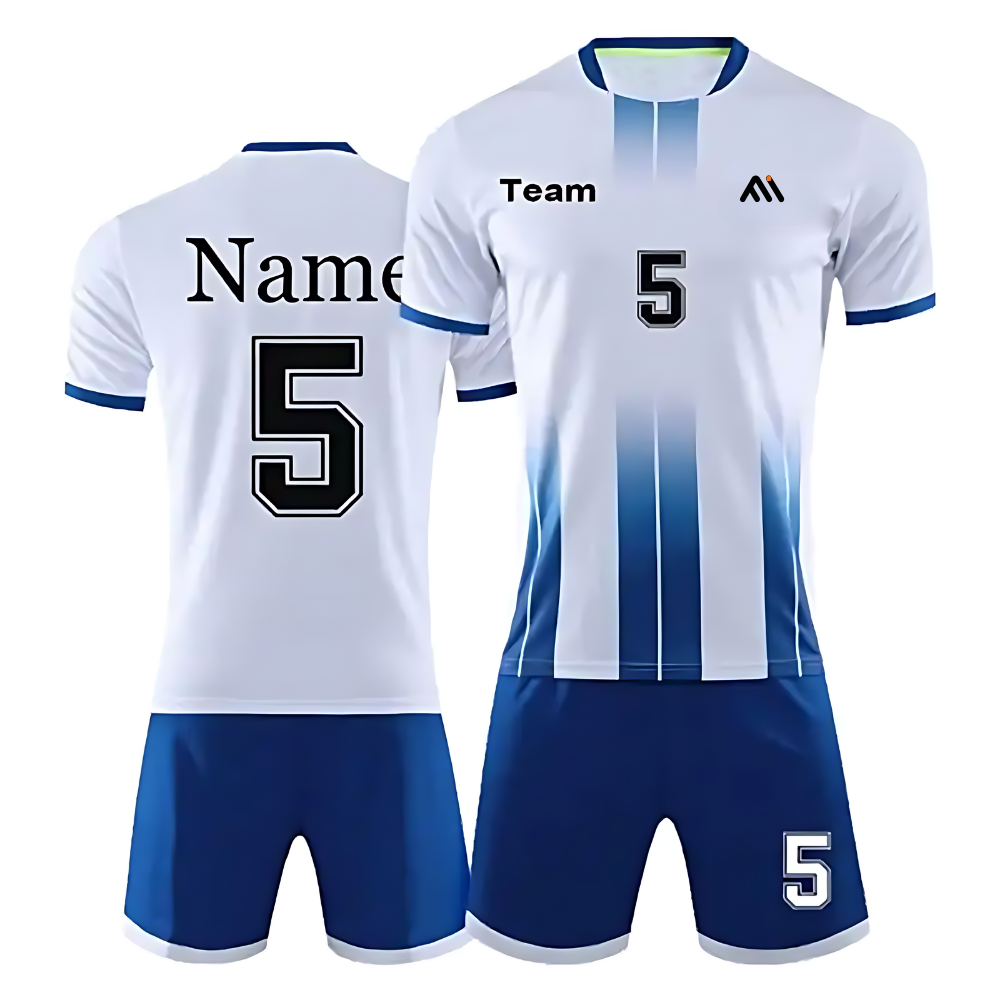
You can see this kind of artwork on the soccer uniform range. ART# MI-2003 is listed as a white jersey with a blue gradient fade, and ART# MI-2005 as a navy jersey with a yellow splatter pattern. Designs like these are typically produced with sublimation. The same applies beyond kits: the sublimated backpack ART# MI-8203 carries a black chevron pattern, and women's tennis tank top ART# MI-1914 a red, blue and white gradient. For jersey-specific design choices, see our guide to custom soccer kits with names and numbers.
Where it falls short
There are four limits to plan around. Sublimation cannot print white, so white in a design comes from the fabric itself. It cannot cover dark fabric. Screen colors rarely match printed colors exactly, because screens mix light and printers mix dye. And the result depends on the polyester content, so a design that looks strong on one fabric can look flat on another.
Other methods fill the gaps. Maswiz product pages list digital, sublimation, screen, emboss, metal foil, high-density, DTG, heat transfer, crackle and reflective printing, along with satin stitching, normal and 3D embroidery for logos. Many orders combine methods, such as a sublimated body with an embroidered crest.
What to prepare before you order
- Artwork as vector files (AI, EPS, SVG or PDF) where possible, or high-resolution images if you have no vectors.
- Exact color references, such as Pantone codes, instead of descriptions like "royal blue".
- The fabric you expect to use, or a request for recommendations.
- A size list, plus names and numbers in a spreadsheet if the order is personalized.
- A request for a printed sample before bulk production.
Minimum order, lead time and sample terms are confirmed in the quotation. Our quote guide lists what to include in your request.
Common mistakes
Sublimating on cotton
The print looks dull and fades in the wash. Choose polyester or change the print method.
Trusting screen colors
Approve colors from a physical sample, not from a monitor.
Low-resolution artwork
A logo pulled from a website will print blurry on a large panel. Send vectors.
Ignoring seams
On all-over designs, patterns can shift where panels join. Ask how the layout is matched.
Frequently asked questions
Is sublimation printing permanent?
The dye sits inside the polyester fiber, so it does not peel or crack. Heavy abrasion, harsh bleach and very high wash or dryer heat can still dull any color, so follow the care guide.
Can you sublimate on cotton?
Not with good results. Cotton does not bond with sublimation dye. Use screen print, heat transfer or embroidery for cotton garments.
Why do printed colors look different from my screen?
Screens emit light and printers use dye, so the same file can look different. Providing Pantone references and approving a sample reduces the gap.
Can names and numbers be sublimated?
Yes, they can be printed as part of the design file. Send them in a clean list so each player's details are matched to the right size.
Planning a sublimated order?
Send your artwork, colors and sizes, and we will confirm fabric options, minimum order, lead time and sample terms in the quotation.


