
Shipping Apparel From Pakistan to the USA and UK: Incoterms Basics
The price on a quotation means little until you know where the supplier’s job ends and yours begins. This guide explains the common Incoterms in plain terms and lists what to agree before a bulk apparel order leaves Sialkot.

- An Incoterm sets who pays for freight, insurance and customs, and when the risk of loss passes to you.
- Quotes on different terms cannot be compared until you add the missing costs to the cheaper-looking one.
- FOB and CIF apply to sea freight only. FCA, CIP, DAP and DDP work for any mode.
- Duty rates and import rules change, so confirm them with your freight forwarder or customs broker.
Why Shipping Terms Change the Price
Two suppliers can quote the same jersey at different prices and still be equally priced. One may quote the goods at the factory gate and the other delivered to your warehouse. The shipping term tells you which costs are inside the number and which are still yours to add.
Incoterms are standard trade terms published by the International Chamber of Commerce. The current set is Incoterms 2020. They cover three things: who arranges and pays for transport, who carries the risk if goods are lost or damaged, and who handles export and import clearance.
For a team kit or a retail range, the term you pick affects your landed cost, your cash flow and how much shipping work you take on yourself. If you want the wider cost picture, read our guide to import duties, customs and landed cost.
The Incoterms Buyers Meet Most
The table is a summary of the standard meaning of each term. Always check the named place, because the same term means something different at a factory than at a port.
| Term | Seller handles | Buyer handles | Transport mode |
|---|---|---|---|
| EXW | Makes the goods available at its premises | Loading, export clearance, freight, insurance, import | Any |
| FCA | Export clearance and delivery to your carrier at a named place | Main freight, insurance, import | Any |
| FOB | Export clearance and loading on the vessel at the named port | Sea freight, insurance, import clearance and duties | Sea only |
| CIF | Export clearance, sea freight and minimum insurance to the destination port | Unloading, import clearance, duties, delivery onward | Sea only |
| CIP | Export clearance, carriage and insurance to a named place | Import clearance, duties, delivery onward | Any |
| DAP | All transport to a named place, ready for unloading | Unloading, import clearance and duties | Any |
| DDP | All transport, import clearance and duties | Unloading | Any |
One detail trips up many first-time importers. Under CIF and CIP the seller pays for freight to the destination, but the risk passes to you much earlier, at loading or when the goods are handed to the first carrier. Paying less freight cost does not mean carrying less risk. Insurance matters for exactly this reason.
How to Choose a Term
Match the term to how much of the shipping you want to run yourself.
You already use a freight forwarder
FCA or FOB usually fits. You pay for the main freight directly, you see the freight rate on its own line, and you keep control of routing and booking. The supplier stays responsible for export clearance and for getting the goods to the agreed point.
You are placing your first import order
DAP gives you one delivered price and fewer moving parts, although you still handle import clearance and duties. Read a delivered quote carefully, because the supplier chooses the carrier.
Which shipping terms Maswiz Industries can quote for your order is confirmed in the quotation. State your destination country and your preferred term in your brief so the quote matches it. Our guide to getting a custom sportswear quote shows what else to include.
Sportswear Styles to Plan Around
Maswiz Industries makes sportswear in Sialkot, Pakistan. Bulky jackets take more carton space than light tops. Three examples from the range:
American Football Uniform ART# MI-7004
Royal blue jersey and pants with white numbers.

Gym T-Shirt ART# MI-9402
Short-sleeve tee with a pale lime tie-dye pattern.
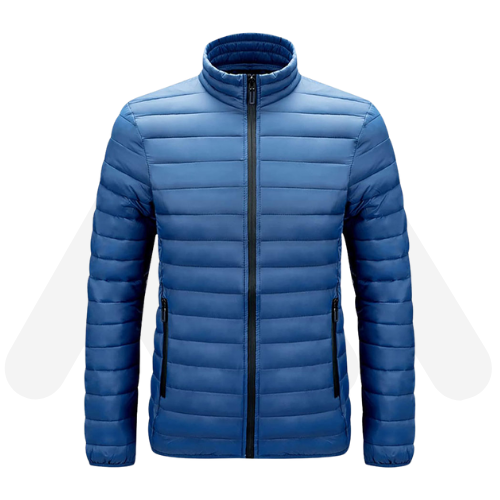
Puffer Jacket ART# MI-8302
Blue puffer jacket with a stand collar and quilted channels.
Browse the full sportswear category for current styles. If your order is tied to a season or a first game, work back from the delivery date with our team uniform order timeline.
Documents and Packing
Customs clears shipments on paperwork, and mismatched paperwork is a common cause of delay. These are the documents buyers normally ask for, shown as general guidance. Your freight forwarder will confirm the exact set for your route:
- Commercial invoice with product descriptions, quantities and values that match the goods
- Packing list showing cartons, pieces per carton and weights
- Bill of lading for sea freight or air waybill for air freight
- Certificate of origin, if your customs rules or a trade agreement call for it
Packing affects both cost and receiving. Freight is often charged by volume or weight, so carton size and folding method change what you pay. See our guide to private label labels and hang tags for what to specify on the garment itself.
Duty rates, tariff classification and import rules differ by product and destination and they change over time. Confirm them with your freight forwarder or customs broker before you commit to a landed-cost budget.
Air Freight or Sea Freight
Sea freight usually has the lowest cost per unit on large volumes, but it takes longer and adds port handling at both ends. Air freight is faster and costs more per kilogram, so it fits small orders, urgent replenishment and samples. Pakistan’s main seaport is Karachi, so goods from Sialkot normally travel overland to the port or to an airport first. Ask who pays for that first leg, because it is easy to miss in a quote.
A common pattern is to send the approved sample by air and the bulk order by sea. Before you do either, read how to approve a sample before bulk production, so that a shipping date is not set on a sample that has not been signed off.
Pre-Order Checklist
Settle these points before you confirm the order:
- The Incoterm and the named place, for example FOB with the port named
- Air or sea freight, and who books it
- Who insures the goods and for what value
- Who acts as importer of record and who clears customs at destination
- The document set the supplier will provide, and when
- Carton marking, packing method and any retail packing needs
- Delivery address and a contact who can receive the shipment
For more on judging a supplier before you order, see our guide on how to choose a sportswear manufacturer.
Frequently Asked Questions
Which Incoterm is best when importing apparel from Pakistan?
There is no single best term. FOB or FCA suits a buyer who already works with a freight forwarder and wants control of the main freight. DAP suits a buyer who prefers one delivered price. Compare the same term across every quote so the prices are like for like.
What does FOB mean for a garment order?
Under FOB the seller clears the goods for export and loads them on the vessel at the named port. From that point the buyer carries the cost and risk of the sea freight, insurance, import clearance and duties. FOB applies to sea freight only.
Who pays import duties on apparel?
It depends on the term. Under EXW, FCA, FOB, CIF, CIP and DAP the buyer normally handles import clearance and pays duties and taxes. Under DDP the seller does. Duty rates change by product and country, so confirm them with your freight forwarder or customs broker.
Should I ship a bulk apparel order by air or by sea?
Sea freight usually costs less per unit for large volumes but takes longer. Air freight is faster and costs more, so it suits small, urgent or sample shipments. Many buyers ship a sample by air and the bulk order by sea.
Ready to Plan Your Order?
Send your styles, quantities, destination and preferred shipping term. Minimum order, lead time and sample terms are confirmed in the quotation.


